CPAP Battery Planning for Caregivers
Build a caregiver-friendly CPAP backup plan with labels, charging routines, runtime notes, and safe escalation rules.
By Max · Published August 5, 2026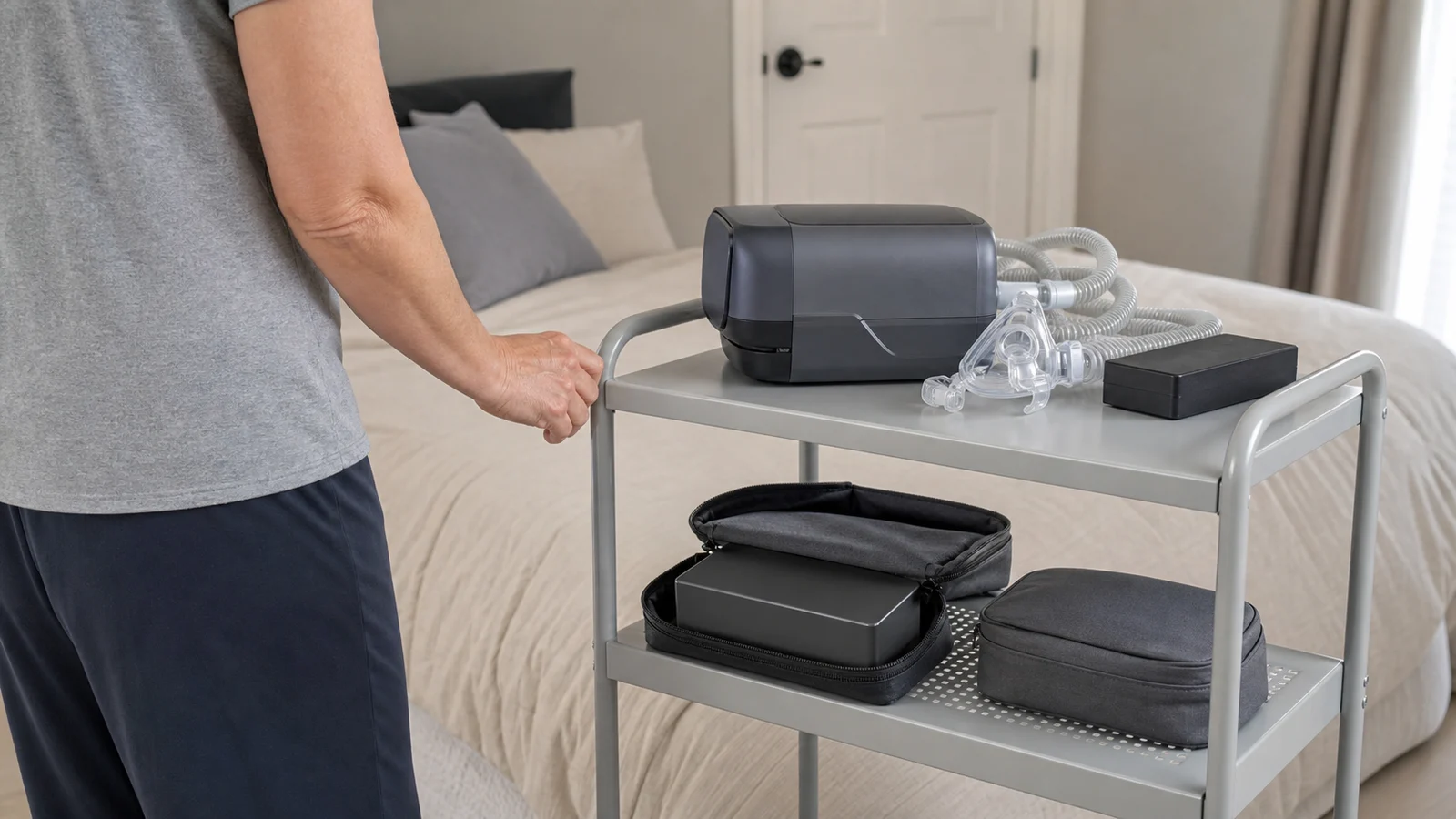
This is backup-power planning information, not medical advice. Follow your device manufacturer's instructions and ask your care team about treatment decisions.
A caregiver CPAP battery plan has to work when the person reading it is tired, the power is out, and the CPAP user may not be able to explain the setup. The goal is not to buy the biggest battery. The goal is to make the correct battery, cable, charger, and instructions impossible to confuse.
Start with one written plan stored with the CPAP kit. Do not rely on memory.
The Caregiver Label
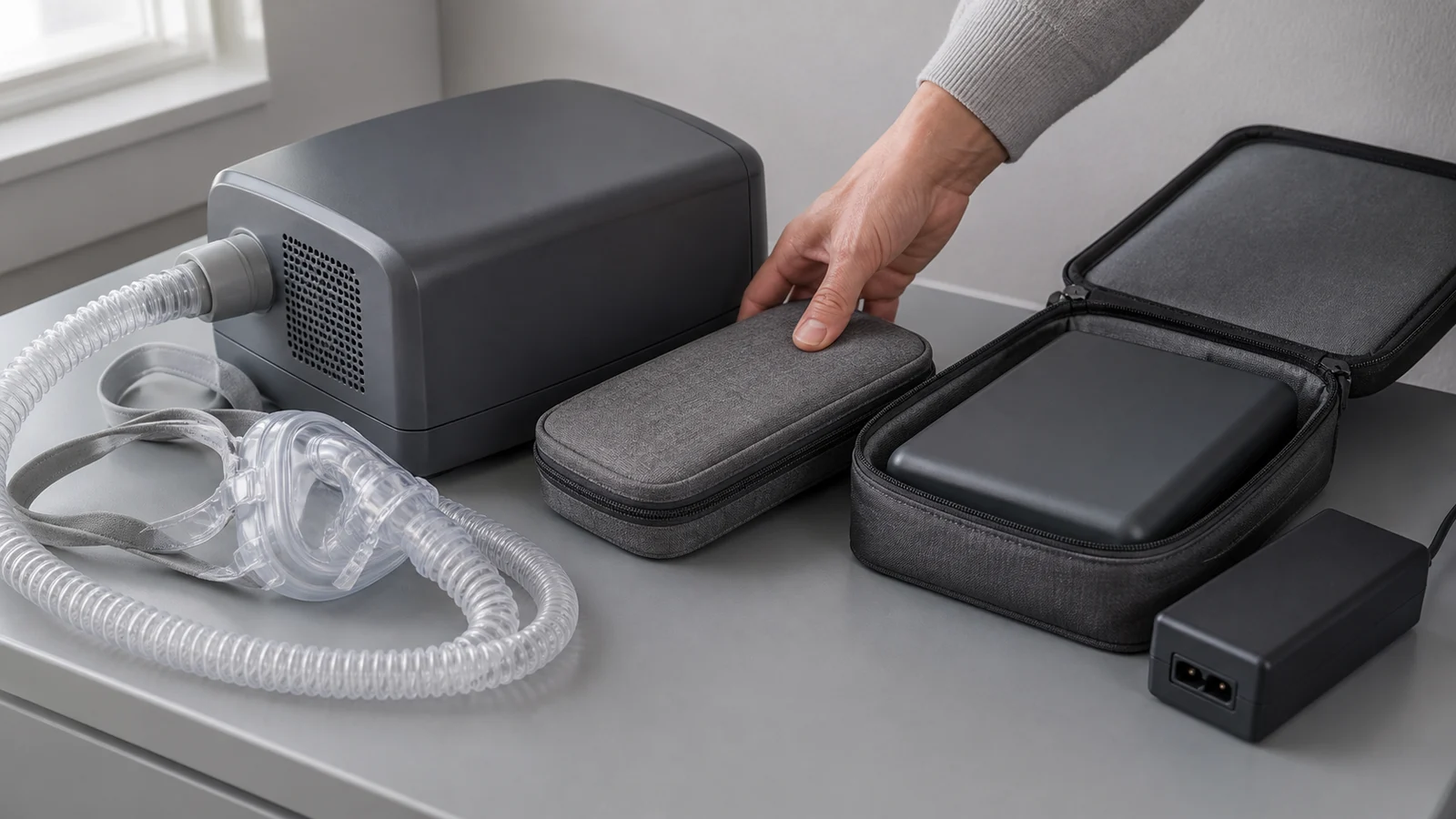
Put a simple label on or inside the battery pouch:
CPAP backup battery
For: [name]
Machine: [exact model]
Use with: [exact cable or AC power cord]
Humidifier during outage: [on/off/setting if clinician approved]
Expected runtime: [hours] at [tested setup]
Last full charge: [date]
Monthly test day: [date]
Do not change pressure settings.
If damaged, swollen, hot, or wet: do not use.
Use plain language. A caregiver should not need to know what IPAP, EPAP, inverter loss, or watt-hours mean to make the safe first move.
Print the label large enough to read in low light and attach it to the cable pouch or battery handle. The first visible lines should identify the battery, the cable, and the machine connection. Put the failure contact and second power option at the bottom so the caregiver does not have to search for a different page if the first attempt fails.
The Three Things To Match
Every backup kit needs three matches:
| Match | Why it matters |
|---|---|
| Machine to power path | ResMed, Philips, Luna, Transcend, and other devices may need different voltage or cables |
| Battery to night length | A compact battery may be enough for one no-humidifier night but not heated humidity or multi-night use |
| Charger to battery | A dead backup battery is just clutter during an outage |
Store the correct cable with the battery, not in a drawer across the room. If the battery uses the CPAP’s AC power cord, write that clearly.
Build The Bedside Kit
Keep the CPAP machine, normal power supply, battery, battery charger, and correct CPAP cable together. If the plan uses the machine’s AC power cord instead of a DC cable, write that on the label. Add the mask, hose, spare filter, spare cushion, a written runtime note, and a small light.
Charge with the supplied or manufacturer-designed charger on a hard, flat surface away from bedding and other combustibles. NFPA lithium-ion battery safety guidance supports this charging boundary; the battery and charger manual controls the CPAP-specific procedure.
The kit should also include the home extension plan if it has already been tested, the DME or provider contact, and instructions for removing or recycling a damaged battery. Do not store loose lithium batteries with metal tools, coins, keys, or random cables touching the terminals.
Build the kit so the first correct action is obvious. The battery should be charged, the cable should already be in the pouch, and the label should name the machine. A caregiver should not have to open three drawers, compare similar black cables, or search online during an outage.
Use separate bags if there are two CPAP users in the home. Mixed cables are one of the easiest ways to turn a working battery into a failed plan. ResMed, Philips, travel machines, and bilevel machines can have different voltage or connector needs, even when the cable ends look familiar.
If the CPAP user travels between homes, keep a duplicate printed plan in each location. Do not assume the caregiver in the second home knows the same storage routine.
Choose The Simplest Power Path The Caregiver Can Execute
The most efficient path is often an approved DC cable. The simplest path may be a battery with an AC outlet that uses the CPAP’s normal power brick. Those are not the same thing.
For an experienced CPAP owner, DC-direct can be worth the extra setup because it avoids inverter loss. For a caregiver, the best setup may be the one that is clearly labeled, has been tested, and can be plugged in correctly without guessing.
Two documented examples show why the machine and cable come first. The Medistrom Pilot-24 Lite compatibility list names AirSense 10, AirSense 11, AirMini, and selected other 24V PAP platforms; Medistrom also says to confirm BiPAP compatibility with technical support. The Zopec Explore Mini product page describes a 99.5Wh battery with a multi-voltage DC outlet and included AirMini and AirSense 11 cables. Neither page proves compatibility with an unlisted machine or the caregiver’s exact setup. Treat these as examples to verify, not purchase recommendations, and check the current manufacturer documentation before ordering.
The best caregiver setup is often the one with the fewest choices. A direct DC cable can improve runtime, but it also creates a cable-selection decision. An AC-outlet battery can waste more energy, but it lets the caregiver use the normal CPAP power brick. The right answer depends on who will plug it in at 2 a.m.
For a caregiver plan, score each option this way:
| Question | Why it matters |
|---|---|
| Can the caregiver identify the correct cable in ten seconds? | Similar cables can carry different voltages |
| Has the exact setup run the CPAP for a real test period? | Box claims do not prove this user’s night |
| Does the battery label explain the humidifier state? | Heat can shorten runtime sharply |
| Is recharge part of the routine? | A battery used once and stored empty may fail later |
| Is there a backup contact if the plan fails? | Caregivers need escalation, not guesswork |
If a setup is efficient but confusing, simplify it or label it better. If a setup is simple but too small, do the runtime math again before buying.
Best CPAP Battery Type For A Caregiver Kit
For a caregiver CPAP battery kit, the best battery is the one the caregiver can use correctly under stress. That often changes the buying decision.
| Caregiver situation | Better starting point |
|---|---|
| One ResMed user, labeled cable, travel backup | Dedicated compatible CPAP battery |
| Machine brand may change or caregiver is unsure | AC-output CPAP battery |
| Home outage with more than one night needed | Larger power station with written setup |
| Advanced PAP, BiPAP, or ASV | Conservative power station plan or clinician-supported DME path |
| Facility or home-aide setting | Simplest approved setup with staff policy checked |
Do not make a caregiver choose between similar cables in the dark. If the correct answer is a DC adapter, label it. If that still feels too error-prone, an AC-output battery may be a better human solution even with lower efficiency.
Monthly Routine
Pick one day each month:
- Check battery charge.
- Recharge to the manufacturer’s storage recommendation if needed.
- Inspect the case for swelling, cracks, heat damage, or port damage.
- Confirm the correct cable is still in the pouch.
- Confirm the CPAP machine still matches the label.
- Run a short test if the manufacturer allows pass-through or battery operation.
- Update the label date.
If the battery is used during an outage, restore the manufacturer-recommended storage charge and update the note. Do not store it empty or assume 100% is always the correct long-term target.
Storage charge is model-specific. Follow the battery manufacturer’s written storage target and temperature limits. If the manufacturer does not provide a clear target, ask the manufacturer or DME provider rather than inventing one. The monthly check can still confirm that the pack is present, undamaged, and ready for the next documented test.
Temperature matters too. Do not store the backup kit in a hot car, a freezing garage, a damp shed, or under bedding. A bedside shelf, closet, or labeled medical-device bin is usually better than a vehicle or attic. If the battery becomes swollen, cracked, wet, unusually hot, or leaking, remove it from service and follow the EPA’s lithium-battery handling guidance and local hazardous-waste instructions. Do not ask a caregiver to decide whether damage is “minor” during an emergency.
Add a calendar reminder for the person most likely to maintain the kit. The CPAP user may be the right person, but in some households it is the spouse, adult child, home aide, or facility staff.
Runtime Notes That Actually Help
“Runs CPAP all night” is too vague. A useful note names the machine model, pressure or setting context if known, humidifier state, heated hose state, connection path, expected hours, test or calculation date, and reserve assumption.
Example:
AirSense 10, humidifier off, standard hose, Medistrom Pilot-24 Lite, DC cable.
Planned for one 8-hour night with reserve. Recalculate if humidifier is used.
That is much safer than a product box claim.
If the plan has two modes, write both:
Normal plan: wall outlet, humidifier setting 3, heated hose on.
Outage plan: battery, DC cable, humidifier off, standard hose.
Expected backup: [hours] at [tested setup], test date [date].
The second line is the important one during an outage. If the caregiver sees only the normal comfort setup, they may leave heat on and drain a compact battery much faster than expected.
For a household with a higher-risk user, record a shorter trigger too:
If the battery is below the minimum level documented by the full-night test or care plan before bedtime,
do not rely on it for the whole night. Call [contact].
That kind of rule is more useful than a long explanation of watt-hours.
What A Caregiver Should Not Do
A caregiver should not change prescribed pressure, BiPAP settings, ASV settings, or ramp behavior to save power. They should not use an unknown cable because it fits physically, cover a charging battery with bedding, or charge a battery on a bed or couch.
Battery condition matters too. Do not use a swollen, wet, cracked, hot, or leaking battery, and do not keep trying after a battery shuts off repeatedly under CPAP load. A travel battery should not be assumed to run heated humidification all night unless that exact setup was tested or calculated with reserve.
If the plan fails, switch to the documented backup contact path: DME provider, clinician instructions, local outage shelter policy, or emergency services if the user depends on therapy and cannot sleep safely without it.
Also avoid improvising with a vehicle starter battery unless the plan was built for that. Running a CPAP from a car outlet can drain the starter battery, and idling a vehicle near a home, garage, or open window creates carbon monoxide risk. If vehicle charging is part of the plan, make it a daytime recharge plan outdoors, with the exhaust kept away from doors, windows, and vents. CDC’s carbon monoxide guidance says never run a car or truck inside an attached garage, even with the garage door open. A clear driver and a documented recharge location are safer than a midnight experiment.
Do not plug a CPAP into a random inverter found in a garage. The inverter may be modified sine wave, undersized, damaged, or connected to a weak battery. If an inverter path is the backup, label the exact inverter and test it with the CPAP before it is needed.
Plan For One Night, Then Plan For The Second Night
Many caregiver plans fail after the first night. The battery works once, then nobody knows how it will recharge before the next sleep period.
Write a second-night plan even if the goal is only one night of backup. It can be simple:
| Situation after first night | Next action |
|---|---|
| Power is back | Recharge battery and update label |
| Power is still out but car travel is safe | Recharge from vehicle or another documented source |
| Power is still out and recharge is not possible | Move to alternate location or contact support |
| Battery or cable failed | Stop using it and follow the contact path |
This does not need to be complicated. The point is to avoid a false sense of security. A compact battery’s label does not establish that it covers one night, and no battery solves a multi-day outage unless recharge is part of the plan.
Facility And Home-Aide Notes
If the CPAP user lives in assisted living, receives home care, or relies on a rotating set of aides, the plan needs to be written for people who may not know the machine. Keep the instructions short enough to fit on one page, then store the longer source notes separately.
The visible page should say what to plug in, what not to change, where the spare mask and filter are, how long the battery is expected to last, and who to call. It should not require a caregiver to read the whole battery manual.
Ask whether the facility has its own backup-power policy. Some facilities may not allow resident lithium batteries to be charged in rooms, while others may require labeling or staff approval. A private home plan and a facility plan are not always the same.
If a facility allows the battery, ask where it should be charged and stored. A battery locked away from the CPAP may be safe from tampering but useless during an outage. A battery stored beside the bed may be easy to use but may need staff labeling or inspection. The right setup is the one the facility will allow and the caregiver can find.
For home aides, keep the instruction card free of jargon. Use the machine name, cable color or label, and one sentence about what not to change. The longer runtime math can stay in the backup folder.
Facility Or Home-Aide Handoff Record
Complete this record with the facility or care coordinator. A blank field is a task to resolve, not permission to guess during an outage.
The handoff record should begin with the resident’s name, exact PAP model, approved battery, and labeled cable. It also needs the facility approval contact and date, permitted charging hours, storage location, and the role allowed to connect the equipment. Those details resolve ownership before a rotating aide encounters the setup during an outage.
The second half should record the expected runtime and tested configuration, last full-night test, location of the normal power brick and spare mask parts, first failure contact, and relocation or second-power plan. Give one copy to the care plan owner and keep one with the equipment. Revisit it when the machine, battery, cable, room, facility policy, or caregiver roster changes.
Handoff Script
Give the caregiver this short version:
- Do not change therapy settings.
- Use the battery and cable in the labeled pouch.
- If the humidifier instruction says off, remove or bypass only as documented.
- If anything looks damaged or hot, do not use the battery.
- If the battery does not work, call the listed contact.
- Recharge after the outage.
What To Buy Only After The Plan Is Written
Buy the battery after the plan is clear, not before. The plan decides whether you need a compact travel battery, a plug-in AC battery, or a larger power station.
If the plan says the caregiver must plug in one normal power brick, do not buy a battery that depends on a voltage-specific cable unless the cable is labeled and tested. If the plan says the battery must cover two nights, do not buy an under-100Wh travel pack because it looks easy to carry. If the plan says the user needs heated humidity, size for heat or choose a different backup path.
Use this purchase note:
Buying goal:
Machine:
Caregiver:
Cable path:
Runtime needed:
Humidifier state:
Recharge plan:
Do not buy if:
That last line matters. A caregiver kit should have skip rules. Examples: do not buy if the cable is not included, if the Wh rating is missing, if the return window is unclear, or if the battery is too small for the documented night.
Common Buying Mistakes
The first mistake is buying a battery before writing the caregiver workflow. A compact battery may look appealing, but it can fail the plan if the caregiver cannot identify the cable or if the battery does not cover the needed hours.
The second mistake is buying for the CPAP user and forgetting the person who will operate the kit. If the CPAP user is not the person plugging in the battery during an outage, the setup has to be designed for the caregiver’s skill and stress level.
The third mistake is leaving recharge out of the plan. A battery that works once still needs a second night answer. A caregiver should know whether to recharge from wall power, a car, a power station, or an alternate location.
The fourth mistake is leaving the normal CPAP power brick out of the kit. AC-output batteries and power stations often need that brick. A battery without the required cable is not backup power.
Related Pages To Use Before Buying
Use the power-outage preparation guide to build the outage plan. Use the battery maintenance guide to build the monthly check routine. Advanced PAP such as BiPAP or ASV needs its own machine-specific backup plan.
The Best Caregiver Setup Is Boring
A good caregiver kit should feel almost too simple. One labeled pouch, one battery, one cable path, one runtime note, and one phone number beat a more flexible kit that requires judgment during an outage. If a product adds modes, ports, adapters, or settings the caregiver will not understand, the instructions need to remove that ambiguity.
The goal is not to teach the caregiver battery theory. The goal is to let them keep the CPAP running without changing therapy settings or guessing which cable is safe.
Hospice And In-Home Care Continuity
Hospice or in-home care can make the power plan more dependent on a caregiver’s routine. The person using the CPAP may not be able to move to another room or location when the power fails, and the home may have other equipment drawing from the same backup source. This section adds the scenario context. The bedside kit and handoff record above remain the operating instructions.
Start by separating the CPAP load from the rest of the home plan. Oxygen equipment, a nebulizer, a hospital bed, a refrigerator, lights, and communications equipment may have different power requirements and different owners. The multi-device power planning guide provides a worksheet for listing each device, its measured or documented energy need, its priority, and the shared recharge budget. Do not subtract one device’s assumed draw from another device’s reserve without evidence.
Because relocation may not be practical, the home plan needs a reliable bedside layer and a clear recharge layer. Keep the tested CPAP battery or station visible, charged according to its instructions, and separate from general household electronics. If a generator or larger home backup is part of the plan, the power outage guide and generator comparison cover the broader setup and carbon-monoxide boundaries. Never run a fuel-burning generator in the home, garage, vehicle, tent, or another enclosed or partly enclosed space.
Write a short power-failure card for the rotating caregiver team:
- Check the home’s outage status and the CPAP battery state.
- Use only the labeled CPAP cable, charger, and power path.
- Keep the CPAP reserve separate from devices that are not part of the documented budget.
- Start the approved recharge layer only as instructed for that equipment.
- Call the named equipment or care-plan contact when a cable, battery, or outlet fails.
- Follow the written alternate-location rule if the bedside plan cannot provide enough power.
The card should identify the person who owns the battery routine. A 24-hour caregiver presence does not guarantee that someone will remember to recharge a battery after a short outage or return it to the bedside kit. Add a visible charge check to the existing maintenance routine and record the last full-night test.
If the home uses several backup systems, document which one powers the CPAP and which one powers the other equipment. A larger battery may have more capacity, but it can still be a poor bedside choice if its controls are confusing, its charging location is inaccessible, or nobody has tested the complete CPAP path. The simplest setup that the assigned caregiver can execute is the useful setup.
This section does not make claims about hospice care, treatment outcomes, or when therapy should be used. Keep those decisions with the patient, care team, and care-plan owner. The battery plan handles electrical continuity, equipment escalation, and a known response when the first power layer is insufficient.
Bottom Line
A caregiver-ready CPAP battery plan is a labeled workflow, not a purchase alone. The battery should match the machine, the cable should live with the battery, the runtime should be written down, and the caregiver should know exactly what not to change.
Sources
- ResMed Battery Guide (manufacturer; retrieved 2026-09-01)
- EPA Frequent Questions on Lithium-Ion Batteries (regulator; retrieved 2026-09-01)
- NFPA Lithium-Ion Battery Safety (regulator; retrieved 2026-09-01)
- EPA Used Lithium-Ion Batteries (regulator; retrieved 2026-09-01)
- Medistrom Pilot-24 Lite product page (manufacturer; retrieved 2026-09-01)
- Zopec Explore Mini product page (manufacturer; retrieved 2026-09-01)
- CDC Carbon Monoxide Poisoning Basics (regulator; retrieved 2026-09-01)