CPAP Power Outage Prep: Build A Backup Plan Before The Lights Go Out
Create a CPAP outage plan that records your machine load, battery capacity, reserve, recharge path, and overnight test results.
By Max · Published July 14, 2026 · Updated September 1, 2026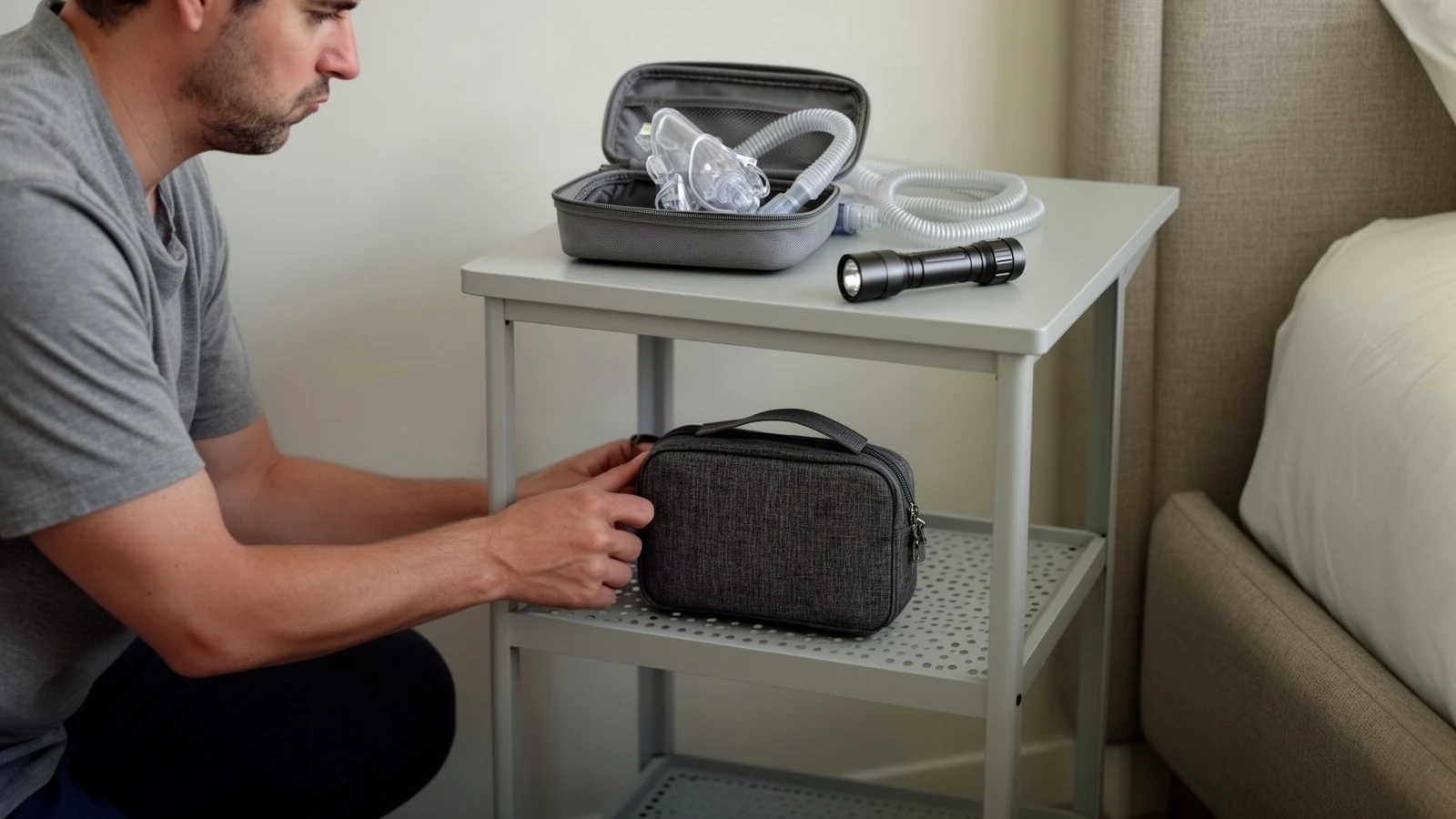
This is backup-power planning information, not medical advice. Follow your device manufacturer's instructions and ask your care team about treatment decisions.
A CPAP outage plan should answer this before the power fails: which exact setup can you run, for how many nights, with what reserve, and how will you recharge it?
Do not start with a shopping list. Start with the operating plan. The battery is only one part of that plan.

The One-Page Outage Plan
Write these fields down in one place:
| Field | What to record | Why it matters |
|---|---|---|
| Machine | Exact model and adapter output | Determines voltage and cable options. |
| Heated humidity | On, off, or emergency setup | Often the largest runtime swing. |
| Heated hose | On or off | Adds another heat load. |
| Connection | Verified DC, DC converter, or AC outlet | Changes conversion loss. |
| Sleep target | Hours per night and number of nights | Defines the energy budget. |
| Battery | Rated Wh, chemistry, age | Nameplate Wh is not fully usable. |
| Recharge | Wall, vehicle, solar, generator, second battery | Multi-day plans need refill. |
| Test result | Date, hours run, ending battery display | Proves the setup before an outage. |
| Handoff | Who can connect the backup and where instructions are stored | Makes the plan usable if you need help. |
| Failure action | Contact, second power option, and relocation point | Prevents a failed cable or battery from ending the plan. |
If you cannot fill in a field, the plan is not ready. That does not mean you cannot use a large AC power station as a fallback. It means the runtime is not calculated yet.
The worksheet also keeps the outage plan honest. A person who writes “AirSense 11, humidifier on, AC outlet, 8 hours, two nights” is describing a much larger problem than someone who writes “AirMini, passive humidity, verified DC path, 7 hours, one night.” The battery shelf label alone does not show that difference.
Keep the plan with the battery. A printed copy of this table becomes the one-page outage record once you add the CPAP user’s name and fill every field. During a real outage, the right answer should not depend on memory, a browser tab, or finding an old product listing. Write the tested result rather than the seller’s runtime claim, and replace the sheet whenever the machine, cable, heated-feature setup, or recharge plan changes.
If Power Stops While You Are Asleep
A CPAP without an operating power source stops delivering powered airflow. Model-specific restart, alert, and therapy-record behavior varies, so check the user guide for your exact machine and test the planned battery handoff while awake. The ResMed AirSense 11 user guide, for example, is the right kind of source for model controls and operating behavior. A generic battery listing is not.
Keep the mask’s normal vents unobstructed and do not improvise changes to therapy settings. The electrical plan is to notice the interruption, connect the labeled backup path, confirm the machine starts therapy, and record the outage afterward. If the user cannot do those steps independently, the caregiver battery plan should identify who will respond.
Pick The Outage Window
Ready.gov recommends planning ahead for power outages, especially when household needs depend on electricity. For CPAP users, the CPAP-specific planning problem is the overnight load.
Choose the target first:
| Target | What the plan must cover |
|---|---|
| One night | Normal sleep session plus reserve. |
| Two nights | One missed recharge or a longer local outage. |
| Three or more nights | Battery plus a tested recharge method. |
A three-night outage plan is rarely just “buy three times the battery.” It also needs recharge timing, cable management, and a decision about what else is allowed to use the battery.
For a one-night plan, the main job is sizing and testing. For a two-night plan, the main job is reserve. For a three-night plan, the main job becomes recharge. Those are different problems.
If your area has short flickers, a UPS-style setup may be more important than large capacity. If your area has long storm outages, capacity and recharge matter more. If evacuation is plausible, the plan also needs portability and a way to keep the CPAP, mask, battery, and cables together.
Pick The Battery Class After The Outage Window
The battery class should come after the outage target. Under-100Wh CPAP batteries are useful for air travel and short fallback use. A 200Wh to 300Wh LiFePO4 station can be a strong one-night home option when paired with the right DC cable. A 500Wh to 1,000Wh station starts to make sense when heated features, multiple nights, or other household loads are part of the plan.
Those are planning classes, not product recommendations. The exact choice still depends on machine draw, connection path, usable capacity, age, and whether the battery has to fly.
If the battery must serve both travel and outage roles, write down which role is primary. The best flight battery is often too small for a serious home outage. The best home outage battery is often too large to fly.
Calculate The Night
Use the same structure every time:
nightly Wh = CPAP operating watts x sleep hours
required battery Wh = nightly Wh x reserve / path efficiency
For public planning on this site, the default reserve is 50%. That is a cautious planning margin for medical-equipment continuity, not a manufacturer guarantee. The reserve should be visible and adjustable.
Example:
30 W estimated load x 8 hours = 240 Wh
240 Wh x 1.5 reserve = 360 Wh
verified DC path at 0.93 = about 387 Wh required
AC path at 0.70 = about 514 Wh required
That same setup needs a larger battery through AC than through a verified DC path.
Now include usable capacity. If the battery is LiFePO4, the local planning default uses 90 percent usable capacity. If it is general lithium-ion, the default uses 80 percent. That means a 512Wh LiFePO4 station is planned at about 461Wh usable before path and reserve. A 512Wh lithium-ion pack is planned at about 410Wh usable.
Age changes the result again. A battery that has been stored for years, especially in heat or at full charge, should not be treated like a new pack. Use the test result as the truth.
Decide Which Setup You Are Actually Planning To Run
This is an electrical inventory, not treatment advice. Do not change prescribed settings because a battery article says so. Instead, decide what setup you intend to support and size the battery for that setup.
Record the mask and tubing you normally use, the humidifier state, the heated hose state, expected sleep duration, and the connection path. If you know the pressure or mode assumptions behind your estimate, record those too. Also write down whether anything else will be plugged into the same battery.
If you normally use heated humidity and want to keep using it during an outage, size and test the battery with heated humidity. A plan that only works after changing the setup is a different plan.
For some users, a separate emergency setup is reasonable. It might use lower humidity, no heated hose, a passive moisture option, or a travel CPAP. But that setup has to be comfortable enough and allowed by the user’s care plan. Do not build an outage plan around a setup the user cannot tolerate for a full night.
Write the emergency setup clearly. If the battery plan assumes humidifier off, the note should say that. If the plan assumes a specific DC cable, store that cable with the battery.
Keep CPAP Reserve Separate From Other Loads
Phones, routers, lamps, fans, and medical accessories can all pull from the same battery. Do not silently spend the CPAP reserve on other devices.
Use a separate mini-budget:
| Load | Planning note |
|---|---|
| CPAP | Primary overnight load. Keep reserve intact. |
| Phone | Small, but count it if charged from the same battery. |
| Router or modem | Can be a continuous load, not a quick charge. |
| Fan | Can be a large overnight load. |
| Lights | Usually small, but easy to overuse. |
If the battery must run more than the CPAP, add those watt-hours explicitly.
A router is the common hidden load. It may not draw much at one moment, but it can run continuously for the whole outage. A small fan can also erase the CPAP reserve. If comfort or communication loads matter, give them their own battery budget instead of borrowing from therapy power.
The cleanest setup is often two batteries: one reserved for CPAP and one for phones, lights, and internet. If you use one large power station for everything, mark the CPAP reserve as untouchable until morning.
Build The Recharge Plan
A battery that covers one night is useful. A battery that covers one night and recharges reliably is much more useful.
Write down how the battery gets refilled. For a short forecast storm, that may be wall charging before the weather arrives. For longer outages, it may be vehicle charging, solar input with a tested panel and cable, a generator or home backup system, or a second battery rotation.
For any fuel-burning generator, follow official generator-safety guidance and keep it outdoors. This guide does not provide generator installation or operating instructions.
Solar recharge needs a reality check. Panel wattage is a lab-style maximum, not what you will always get during a storm. Shade, clouds, winter sun angle, and charge-controller limits can all slow the refill. Test the panel with the same battery before counting on it.
Vehicle charging can help, but it should not turn into draining the starter battery overnight. Use a running vehicle only where safe and legal, or use a house battery system in an RV or van. The recharge plan should say how long the battery takes to refill and what cable or adapter is required.
If a generator is part of the household plan, keep CPAP planning separate from generator safety. Follow official generator guidance for carbon monoxide and outdoor placement. The CPAP power plan does not replace generator safety instructions.
Test The Setup Before You Need It
Run one controlled overnight test:
- Charge the battery fully.
- Use the exact CPAP setup planned for an outage.
- Do not plug in other devices.
- Record starting battery display.
- Record ending battery display.
- Record hours used.
- Recharge the battery and note recharge time.
If the result is shorter than expected, do not explain it away. Recalculate with the actual connection path, heated features, battery age, and reserve. The short-runtime troubleshooting guide walks through those failure points.
The test should be boring. If you have to watch the battery anxiously, reset the CPAP, move cables, or turn off settings halfway through, the plan is not ready. A good test produces a simple record: started full, ran the planned setup, ended with enough reserve, recharged in a known time.
Repeat the test after major changes. A new mask, different hose, cold room, older battery, or switch from DC to AC can change the result.
What To Keep With The Battery
Keep the power-specific parts together: the CPAP power supply, verified DC cable or converter, battery charger, and an extension cord for AC fallback. Add the battery manual or a photo of the output specs, the written setup plan, the last test date, and a small light.
Follow the battery manufacturer’s storage instructions. Do not assume every lithium battery should be stored full or empty for long periods.
Add labels. Label the CPAP cable, the battery charger, and any adapter that should not be mixed with other devices. If a caregiver may help, add one page with the machine name, battery name, cable path, and what not to change.
Store the kit where it can be reached in the dark. A battery in the garage and the CPAP cable in a travel pouch is not a ready plan.
When A Portable Battery Is Not Enough
Some situations need broader emergency planning. Frequent multi-day outages, no reliable recharge option, multiple medical devices, climate-control needs, evacuation risk, or a household member who cannot manage equipment alone all change the plan.
In those cases, treat the CPAP battery as one part of the household plan. Contact the utility, local emergency management, and your care team where appropriate.
Some households should also ask about medical baseline, priority notification, or local emergency programs. Those programs do not guarantee power, but they can be part of preparation. Keep the CPAP kit ready even if you register with a utility, because restoration timing is never a personal runtime plan.
Three Example Outage Plans
For a short flicker-prone home, the plan may be a UPS-capable power station or CPAP battery that has passed a live unplug test. The battery does not need to cover three nights if the real risk is a ten-minute outage while asleep. It does need fast transfer behavior and a known restart result.
For a one-night storm plan, the plan may be a mid-size battery, verified DC cable, and no other loads on the CPAP reserve. The test should prove the intended sleep window plus reserve. Recharge matters, but it is less central than the first full night.
For a multi-day outage area, the battery is only one piece. The plan needs a larger capacity class, recharge method, storage routine, cable labels, and rules for phones, fans, routers, and lights. A multi-day plan with no recharge method is only a larger one-night plan.
Apartment And Emergency-Shelter Plans
Planning In An Apartment
Apartment plans are constrained by shared buildings, limited outdoor space, and rules about charging or generators. Add the building’s outage contact and the stairs or elevator plan to the one-page record. Name a place outside the affected building where the battery can be recharged, then choose a relocation point before the remaining capacity falls below one tested night plus reserve.
Never run a fuel-burning generator in an apartment, garage, hallway, balcony, or near doors, windows, and vents. Ready.gov’s outage guidance says generators belong outdoors at least 20 feet from windows, doors, and attached garages. That makes generator placement and carbon monoxide life-safety constraints, not conveniences to solve after the power fails. If the building limits resident battery charging, confirm the allowed charging and storage location before relying on the pack.
Arriving At An Emergency Shelter
An emergency shelter may have outlets without having the right cable, guaranteed overnight power, or staff familiar with the machine. The intake note should name the exact PAP model, its required power path, the battery’s rated Wh and current charge, the tested runtime, and the charging equipment you brought. It should also say whether you can connect the equipment independently and identify the caregiver or equipment-provider contact.
Ready.gov’s shelter guidance advises bringing an emergency supply kit even though mass-care shelters provide basic life-sustaining services. For a CPAP user, the machine, normal power supply, tested battery cable, charger, mask parts, and intake note are the power-dependent part of that kit.
Tell shelter staff that therapy settings should not be changed as part of the power plan. Ask which outlet can remain available overnight and when battery charging is allowed. An offered outlet is not yet a complete solution: connect the normal power supply or tested battery path and confirm that the machine starts therapy before bedtime.
Utility Program Check
Medical-baseline, critical-care, or priority-notification programs can improve communication or billing support, but enrollment is not a guarantee of uninterrupted service or faster restoration. Use the utility’s current program page to confirm the name and eligibility rule. Keep the application date, any clinician-certification expiration, alert settings, emergency or accessibility phone number, and next renewal date with the outage record. Recheck those details when moving or changing utilities because the program and terminology are local.
Keep the independent battery and relocation plan even after approval. A utility record helps with coordination. It does not add watt-hours to the battery.
Planned Shutoffs And Hurricanes
The electrical math does not change with the storm name, but the logistics do. A planned public-safety shutoff gives a charging window. A hurricane may make travel and fuel access harder after landfall.
Wildfire Or Public-Safety Shutoff
Use the warning window to charge the battery and move the entire CPAP kit indoors before smoke, evacuation traffic, or a shutoff complicates the job. The plan should name an indoor sleeping location with acceptable air conditions, an evacuation destination, and a daytime recharge source outside the affected area. Check the route and transport contact while communications still work.
Ready.gov’s wildfire guidance says to learn evacuation routes, identify where you will go, keep phones charged, and leave immediately when authorities direct it. The CPAP plan fits inside that evacuation decision. It does not delay or override it.
Choose the relocation threshold from tested battery nights, not the utility’s estimated restoration time. If the plan requires driving to recharge, leave enough stored energy to cover delays or a charger that is unavailable when you arrive.
Hurricane Preparation
Before landfall, compare the expected outage window with the number of tested nights the battery can cover after reserve. Store the CPAP, power supply, battery, and cables above the plausible flood level and together in a bag that can leave with the user. A recharge plan that depends on fuel or driving should account for closures and shortages rather than assuming the normal trip remains possible.
Ready.gov’s hurricane guidance identifies storm surge, wind, and flooding as major hazards. Those hazards are why the power equipment needs a flood-aware storage location and why the departure decision comes before road conditions deteriorate.
Verify outlet access at the evacuation destination and choose a decision deadline before weather or roads deteriorate. A larger battery can delay that deadline, but it does not replace a safe transport and destination plan.
Do not wait for the battery to reach zero before relocating. Set the decision point while one tested night plus the chosen reserve still remains.
Caregiver Version Of The Plan
If someone else may set up the battery, write a simpler version. Include the machine name, battery name, correct cable, normal power brick location, and the exact order of steps. Also include what not to change: pressure settings, mask parts, random cable tips, and humidifier assumptions.
Use plain labels. “Use this cable for AirSense 11” is better than a technical note hidden in a manual. Store the written plan with the battery, not in a folder across the room.
A caregiver plan should also define the failure action. If the battery does not power the CPAP, the caregiver should know who to call, whether there is a second battery, and whether the original wall power path should be restored when power returns.
Evacuation And Travel Bag Notes
An outage plan can fail during evacuation because the battery and CPAP accessories get separated. Keep the CPAP power supply, DC cable, battery charger, mask parts, and written plan in one bag or one labeled bin. If the battery must fly, keep the watt-hour label documentation with it.
Do not assume the same battery is best for home and evacuation. A 700Wh power station can be useful at home but too heavy for quick travel. A 95Wh travel battery can be easy to pack but too small for a heated home setup. If both scenarios matter, write two plans.
Monthly Readiness Check
A monthly check can be short. Confirm the battery turns on, the charge is within the manufacturer’s recommended storage range, the cable pouch is complete, and the last full-night test is still recent enough to trust. If the battery was used, recharge it and update the note.
Do a full overnight test after buying a new battery, changing CPAP machines, changing the cable path, or entering storm season. The monthly check keeps the kit ready. The overnight test proves the plan.
How Much Reserve Is Enough?
This site uses 50 percent reserve as the default because CPAP is medical equipment and because real outages include leaks, colder rooms, longer sleep, older batteries, and imperfect estimates. It is a planning margin, not a manufacturer rule. ResMed’s battery guide also builds a 50 percent safety margin into its amp-hour sizing tables for supported machines, which makes the default a reasonable starting point for cautious planning.
Some users may choose a smaller reserve for a short, low-risk backup. Others may choose a larger reserve for severe weather, advanced PAP, cold rooms, or no recharge option. The important point is to choose the reserve on purpose and write it down.
If a battery only passes with no reserve, it is not a dependable outage plan. It may still be a partial fallback, but the label should say that.
What Success Looks Like
A ready outage plan should be boring. The battery is charged and stored correctly. The CPAP cable is labeled. The setup has run for the target sleep window. The recharge method has been tested. Other devices have their own budget. A caregiver can follow the written steps.
If any part depends on memory, a guess, or a favorable product claim, that part still needs work. The goal is not to own a battery. The goal is to wake up after an outage with the CPAP still running and enough information to recharge or adjust the next night.
Simple Launch Checklist
Before relying on the setup, you should be able to say yes to each item:
- I know my machine model and power input.
- I know whether my runtime estimate is verified or estimated.
- I know whether I am using DC or AC.
- I sized for my intended heated-feature setup.
- I included a reserve.
- I kept other battery loads separate.
- I tested the setup overnight.
- I have a recharge plan.
Next step: use the multi-night planner for the number of nights you want to cover, then run one real overnight test with the exact setup.
Sources
- Ready.gov Power Outages (regulator; retrieved 2026-09-01)
- Ready.gov Shelter Guidance (regulator; retrieved 2026-09-01)
- Ready.gov Wildfire Guidance (regulator; retrieved 2026-09-01)
- Ready.gov Hurricane Guidance (regulator; retrieved 2026-09-01)
- ResMed Battery Guide (manufacturer; retrieved 2026-09-01)
- ResMed AirSense 11 User Guide (manufacturer; retrieved 2026-09-01)