BiPAP and ASV Battery Backup: How to Size Power More Conservatively
Size battery backup for BiPAP, bilevel, and ASV machines with conservative assumptions for pressure, humidification, connection loss, and reserve.
By Max · Published July 30, 2026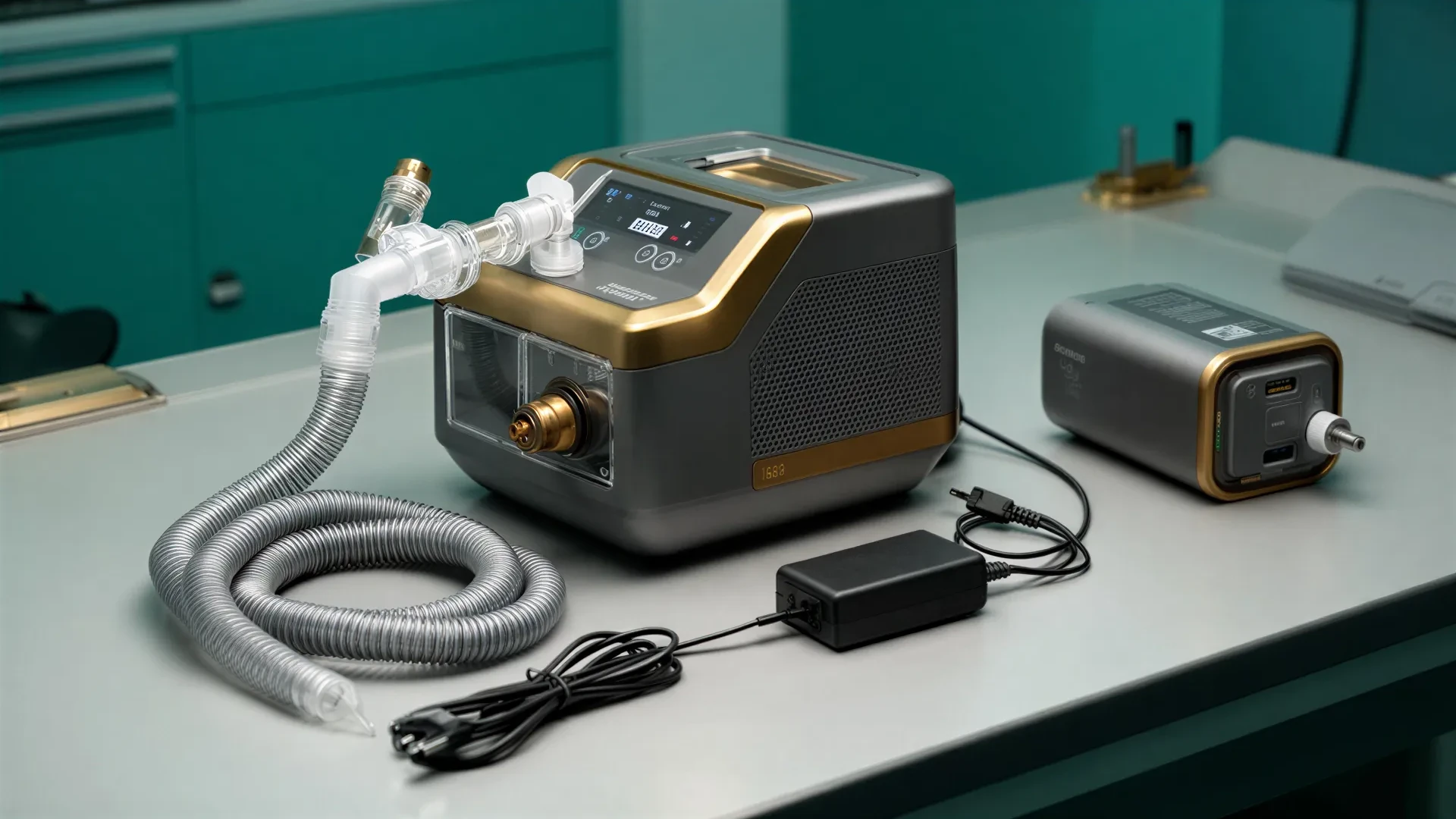
This is backup-power planning information, not medical advice. Follow your device manufacturer's instructions and ask your care team about treatment decisions.
BiPAP, bilevel, VPAP, and ASV backup power should be sized more conservatively than a basic travel CPAP setup. For one concrete example, the ResMed AirCurve 11 user guide lists a 90W supply, but that is a model-specific requirement, not a universal advanced-PAP draw. A small travel battery can work for some no-humidifier setups, but it is not a safe default assumption.
The rule: size from your exact machine, pressure range, humidifier state, connection path, and hours. Do not borrow runtime claims from standard CPAP pages.
Why Advanced PAP Uses A Bigger Margin
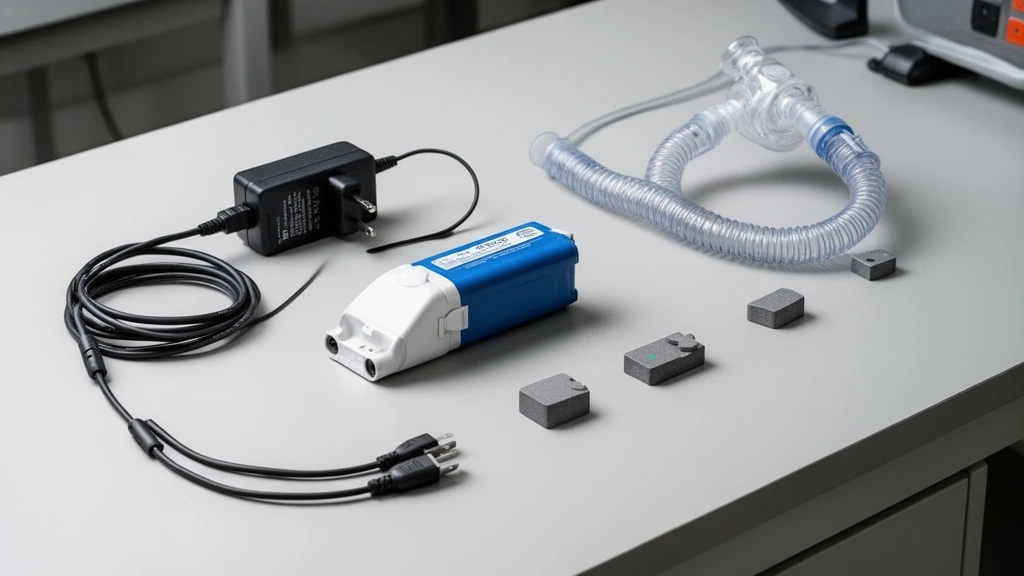
BiPAP and ASV machines are not automatically high-power all night, but their load can vary with the exact mode, pressure support, leak behavior, and accessories. The manufacturer material cited here does not convert those variables into a universal pressure-to-watt or leak-to-runtime rule, so measure the exact prescribed setup instead of converting pressure into a battery size.
The accessory and power path choices matter as much as the machine mode. Heated humidifiers and heated hoses can dominate the energy budget. AC inverter paths waste capacity compared with direct DC where approved, and some machines need a specific voltage converter or proprietary cable.
ResMed’s battery guide is useful because it separates converter and inverter paths and tells readers to identify the device, treatment pressure, and matching converter. It also warns that its battery tables are built for specific components and assumptions. That is the right mindset for BiPAP and ASV: verify the path first, then calculate runtime.
A Conservative Sizing Screen
Use this screen before selecting a battery:
| Question | Safer answer |
|---|---|
| Do you know the exact machine model? | Yes, including AirCurve, DreamStation BiPAP, Luna G3 BiLevel, or ASV variant |
| Do you know whether humidifier and heated hose will be used? | Yes, and runtime is calculated for that state |
| Is the cable approved for the machine voltage? | Yes, from manufacturer or known-compatible battery maker |
| Is runtime based on usable Wh, not advertised mAh? | Yes |
| Is the site’s 1.50 reserve multiplier included? | Yes, unless a documented product-specific test supports a different plan |
| Will someone change pressure to save power? | No |
If any answer is no, treat the runtime as unproven.
That screen is stricter than a normal CPAP battery checklist because the downside is different. A standard CPAP user with humidifier off may discover that a small battery runs shorter than expected and still have time to change the plan before the next outage. A bilevel or ASV user may be planning around higher pressure support, a more sensitive power brick, and a setup that another person has to operate. The plan needs more margin before the purchase, not after the first failed night.
Write the answers down before you shop. The useful shopping note is not “BiPAP battery.” It is closer to this:
Machine: AirCurve 10 or AirCurve 11 class bilevel
Use case: one outage night, 8 hours
Humidifier: off for outage plan, tested while awake
Connection: approved 24V DC path if available, AC only if DC path is not verified
Reserve: 1.50 site planning multiplier because battery failure would be high impact
That note prevents a common mistake: buying a compact travel battery because it claims CPAP support, then discovering later that the claim was based on a lower-draw setup.
What To Use For Load
Start with the strongest available source. A manufacturer battery guide or compatibility table is best. A manufacturer user guide or power-supply specification is still useful, and a battery manufacturer compatibility table can help when it names your exact machine. Your own measured setup is also valid if you record the conditions.
If the only number you have is the power-brick rating, use it as a ceiling, not typical runtime. A 90W supply does not mean the machine draws 90W all night, but it tells you the battery and inverter must be able to support the possible load.
If your machine reports usage data, check leaks as part of the setup record before sizing backup power. A leak history can make a runtime estimate less transferable, but it is not a source-backed wattage conversion. Do not change therapy settings to chase runtime. Resolve mask fit, hose condition, and the power path with the care team or equipment provider.
The cleanest evidence hierarchy is:
| Evidence | How to use it |
|---|---|
| Manufacturer battery guide for your exact machine | Best starting point for voltage, pressure, and cable assumptions |
| Official power supply label | Treat as a maximum capability requirement, not average draw |
| Battery maker compatibility table naming your machine | Useful only when the cable and machine generation are exact |
| Your own overnight test | Strong for your setup when you record humidifier state, hours, and reserve |
| Forum or review runtime report | Background only. Do not use it as the core sizing number |
If the only available evidence is another user’s runtime report, wait before buying an expensive backup. Their pressure, leak, hose, humidifier, battery age, room temperature, and connection path may all differ from yours.
Published Draw Data For BiPAP And ASV
The available machine data shows why a BiPAP or ASV estimate needs a wider margin. The figures below are evidence for the named models and configurations, not a universal advanced-PAP wattage.
| Machine or class | Published power information | How to use it |
|---|---|---|
| ResMed AirCurve 11 VAuto or ASV | The official user guide lists a 90 W power supply, typical consumption of 65.3 W, and peak consumption of 103.4 W | Use 65.3 W only for the guide’s documented configuration and treat the peak as an output ceiling. See the AirCurve 11 user guide, retrieved 2026-09-01. |
| Löwenstein prisma25ST | The manufacturer identifies a separate bilevel platform, but the page does not provide a universal overnight load | Confirm the exact model’s power rating, adapter, and intended setup in its current manual before sizing backup. See the prisma25ST product page, retrieved 2026-09-01. |
| React Health Luna G3 Bilevel 25A | The manufacturer documents DC capability and a 24 V, 18 W heated-tubing communications port. It does not provide a matching overnight measurement for the base and humidified load | Use the machine’s documented path and keep the heated-tubing load separate from the base-machine estimate. See the Luna G3 Bilevel product page, retrieved 2026-09-01. |
The AirCurve figures describe the configuration documented in the official guide; they are not a model-wide overnight measurement. A 90 W supply also does not mean the machine consumes 90 W all night. It tells you what the supply and power path must be able to support.
For a rough AirCurve example, the guide’s 65.3 W figure multiplied by eight hours is about 522 Wh at the AC input. Applying the runtime calculator’s conservative 0.70 AC-path planning efficiency and its 1.50 reserve multiplier gives roughly 1,119 Wh of battery energy before any additional usable-capacity adjustment. This is an illustration of the documented configuration, not a universal AirCurve or ASV runtime.
Use the CPAP power consumption guide with the runtime calculator to keep the draw label, connection path, reserve, and uncertainty visible. A preset does not replace checking the exact machine and accessories.
Battery Examples, Not Universal Picks
These examples are included to show how the decision changes by connection path. They are not product awards and they do not replace machine-specific compatibility checks.
The Medistrom Pilot-24 Lite compatibility list is a cable-specific 24V example, not proof of universal bilevel support; Medistrom directs buyers to confirm BiPAP compatibility with technical support. The Zopec Explore Mini product page describes a multi-voltage DC battery with named AirMini and AirSense 11 cables, not a universal BiPAP or ASV solution. Neither example replaces exact written compatibility and a conservative runtime test.
For heated humidification, multi-night backup, or high-pressure ASV, a sub-100Wh battery may become a short fallback rather than an all-night solution. Calculate the measured setup first and confirm that the machine can run safely from the selected output path.
Best Battery Type For BiPAP And ASV Backup
For searchers looking for the best BiPAP battery backup, the honest answer is usually a product class, not one product. Advanced PAP users should start with the class that matches the use case:
| Use case | Better battery class | Why |
|---|---|---|
| Short travel fallback, no heat, compatible ResMed 24V | Dedicated CPAP battery | Light and easier to pack |
| Mixed machine brands or caregiver plug-in use | AC-output CPAP battery | Uses the normal power brick |
| One full outage night with reserve | Power station sized from the measured load | More room may be available for higher draw and aging |
| Heated humidity or ASV uncertainty | A power station sized from the heated setup | Heater load and pressure support need measured margin |
| RV or van setup | House battery or power station with verified DC cable | Recharge and DC efficiency matter |
The phrase “BiPAP battery” is often used too loosely. A battery that runs a standard CPAP for a few hours may not be the right BiPAP or ASV battery backup. The machine mode, pressure support, humidifier state, and cable path decide the result.
For a serious home backup, a larger power station with a documented pure sine AC output or correct DC path is often a more practical starting point. For a flight, the airline battery limit may force a smaller dedicated battery and a shorter runtime expectation. Those are different jobs.
The Formula
Use this planning formula:
delivered Wh = machine watts x hours
minimum rated Wh = delivered Wh / path efficiency / usable-capacity factor x reserve multiplier
Reasonable planning placeholders:
| Variable | Conservative placeholder |
|---|---|
| Direct DC path efficiency | 0.93 site planning value unless product-specific evidence is available |
| AC inverter path efficiency | 0.70 site planning value for the complete AC path |
| New battery usable factor | 0.90 LiFePO4 or 0.80 Li-ion site planning value |
| Reserve multiplier | 1.50 site planning value |
| Older battery reserve | Add more or replace if capacity has noticeably dropped |
Example: if an advanced PAP setup averages 35W for 8 hours through the conservative 0.70 AC path, it uses 280Wh at the machine. The canonical calculation applies the 1.50 reserve multiplier and then divides by path efficiency and the applicable usable-capacity factor. Replace 35W with a full-night measurement from the exact machine and accessories. If the battery is older, stored hot, or charged only occasionally, account for that condition rather than presenting a generic capacity as sufficient.
Here are three planning profiles that show why the same battery can be sensible for one user and wrong for another:
| Planning profile | What changes | Battery implication |
|---|---|---|
| One-night bilevel, humidifier off, verified DC path | Lower conversion loss and lower heat load | A compact or mid-size CPAP battery may work after calculation |
| One-night bilevel with heated humidity | Heater becomes a major load | Under-100Wh batteries are usually short fallback tools |
| ASV, high pressure support, no reliable recharge | Higher uncertainty and higher consequence of failure | Size like a home backup problem, not a travel accessory |
The pressure number alone does not decide the battery. The combination of pressure, leaks, humidification, connection path, night length, and recharge plan decides it.
Humidifier Decisions
Do not change prescribed pressure, mode, backup rate, or other clinical settings to save battery. If you are considering a temporary humidifier or heated-hose change for an outage, follow the machine manufacturer’s instructions and discuss comfort and care needs with your clinician or DME.
If you plan to turn humidification down or off during an outage, test comfort while power is available and document the exact steps. A caregiver should not be guessing through menus at midnight.
For advanced PAP, a humidifier decision should be written as two separate plans:
| Plan | When it applies | What to record |
|---|---|---|
| Comfort plan | Normal AC power is available | Usual humidifier and heated hose settings |
| Outage plan | Battery runtime matters | Exact humidifier state, hose state, and whether this was discussed with the care team |
Do not let the outage plan become hidden medical advice. The article can explain the electrical effect of heat. Your clinician or DME owns the therapy decision, especially when dryness, congestion, or mask leak makes lower humidity hard to tolerate.
When A Larger Power Station Makes Sense
Consider larger capacity when heated humidification is part of the plan, the mode is BiPAP ST or ASV, the outage plan needs more than one night, or daily recharge is not realistic. You also need more margin when the user cannot tolerate a failed night or the battery is supporting a modem, oxygen concentrator accessories, or other devices.
Do not choose capacity by price alone. A larger battery that lacks documented pure sine AC, the correct DC voltage, ventilation, or safety documentation may be the wrong tool.
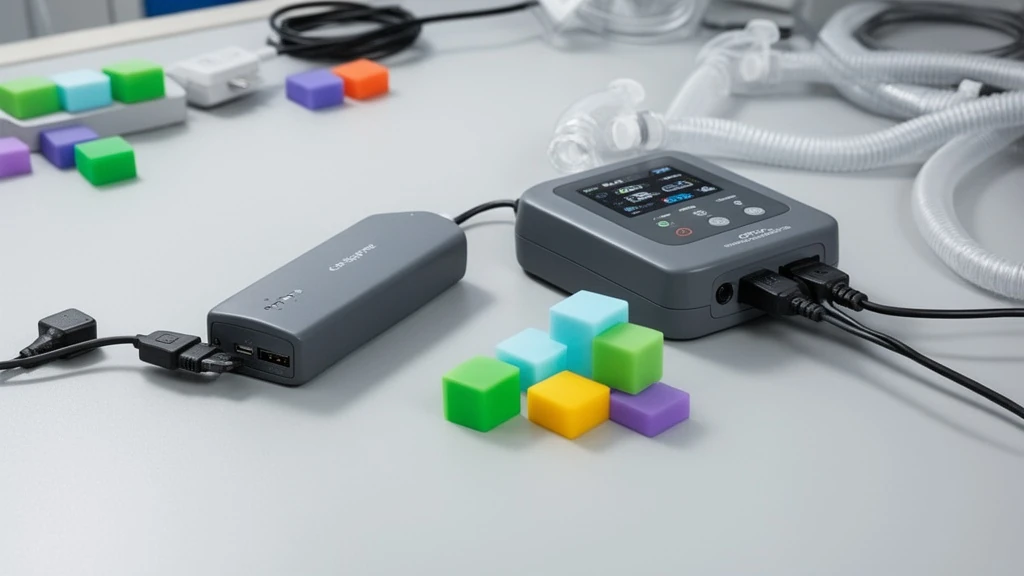
A larger power station can be the right answer when the CPAP battery category is too small. It also adds new checks. If you must use AC, look for a pure sine inverter, enough continuous wattage for the power brick, and a battery capacity that still works after inverter loss and reserve. If the station has a regulated DC output that matches an approved CPAP adapter, that path may be better than the AC outlet.
Pass-through charging should not be treated as a medical UPS unless the manufacturer documents the transfer behavior and you test it with the CPAP. Some portable stations switch fast enough for many electronics. Others drop power long enough for a CPAP to shut down, and some machines do not restart therapy automatically after power returns.
For a household where the battery supports an advanced PAP user, write down the failure plan too. Include who checks the battery charge, who knows the cable path, where the normal AC brick is stored, and what to do if the machine shuts off overnight. More capacity does not replace a clear workflow.
Who Should Not Use A Small Travel Battery As The Main Plan
A sub-100Wh battery is attractive because it is compact and often easier for air travel. It is not a universal backup for bilevel or ASV.
Skip the small-battery-first plan when any of these are true:
- You need heated humidification for the backup night.
- The machine is ASV or another advanced mode with higher uncertainty.
- The user cannot safely tolerate a failed night of therapy.
- The caregiver cannot verify the cable path without help.
- The setup has not been tested for a full night.
- Recharge before the next sleep period is uncertain.
In those cases, start from the required runtime and size from the measured setup. The result may be larger than a travel battery, but the page should not choose a capacity class without the reader’s load, hours, path, reserve, and usable-capacity inputs.
Buying Checklist For Advanced PAP Batteries
Before buying, answer these questions in order:
- What exact machine model is being powered?
- Does the battery support the correct voltage and connector?
- Is the plan DC direct, AC outlet, or both?
- Will the humidifier or heated hose run?
- How many sleep hours need coverage?
- What reserve is required if the user cannot tolerate failure?
- How will the battery recharge before the next night?
- Who will operate the setup during an outage?
If a product listing does not help answer those questions, it is not enough evidence for an advanced PAP purchase. Look for the manufacturer manual, battery guide, cable chart, and return policy.
What To Record After A Test Night
A test night is valuable only if the result can be repeated. Record the machine model, mode, pressure range if available, mask type, humidifier setting, hose type, battery model, connection path, room temperature, hours used, and remaining battery percentage or watt-hours.
Also record anything that went wrong. A battery that works for three hours and then shuts off under load did not pass. A cable that gets hot did not pass. A setup that works only with the humidifier off should be labeled that way so nobody turns heat back on during an outage and expects the same runtime.
Retest after major changes: new mask, new hose, new battery, different machine, higher prescribed settings, or a battery stored for a long time. Advanced PAP backup power is not a one-time purchase decision. It is a small system that needs periodic proof.
Alternatives To Buying A Bigger Battery
Sometimes the right answer is a larger battery. Sometimes the better answer is improving the setup around the battery.
Record leak behavior as part of the test conditions rather than turning it into a wattage estimate. Then verify the DC path. Moving from AC inverter output to a correct DC cable can save enough energy to change the battery size. Finally, separate comfort settings from therapy settings. Pressure, mode, and backup rate are clinical settings. Humidifier and hose heat are power loads that some users can plan differently after checking comfort and care-team guidance.
If those steps still leave the battery too small, buy more capacity. Do not keep shrinking reserve until the math barely works.
Related Pages To Use Before Buying
Use the machine compatibility guide to verify the voltage and cable path. Use the DC vs AC connection guide to understand conversion loss.
Those pages keep this guide focused on advanced PAP sizing instead of turning it into a product list.
Bottom Line
BiPAP and ASV backup power is more than a larger CPAP battery. It is a separate sizing problem. Verify the machine, cable, humidifier state, and path efficiency, then add reserve. Compact batteries can be useful, but for advanced PAP they should be treated as calculated tools, not generic one-night promises.
Sources
- ResMed Battery Guide (manufacturer; retrieved 2026-09-01)
- ResMed AirCurve 11 bilevel product page (manufacturer; retrieved 2026-09-01)
- Medistrom Pilot-24 Lite product page (manufacturer; retrieved 2026-09-01)
- Zopec Explore Mini product page (manufacturer; retrieved 2026-09-01)
- ResMed AirCurve 11 user guide (manufacturer; retrieved 2026-09-01)
- Löwenstein prisma25ST product page (manufacturer; retrieved 2026-09-01)
- React Health Luna G3 Bilevel 25A product page (manufacturer; retrieved 2026-09-01)