DC vs AC CPAP Battery Connection: Which Path Wastes Less Power?
Compare CPAP DC cable, DC converter, and AC inverter paths so battery runtime estimates use the right conversion-loss assumptions.
By Max · Published July 14, 2026 · Updated September 1, 2026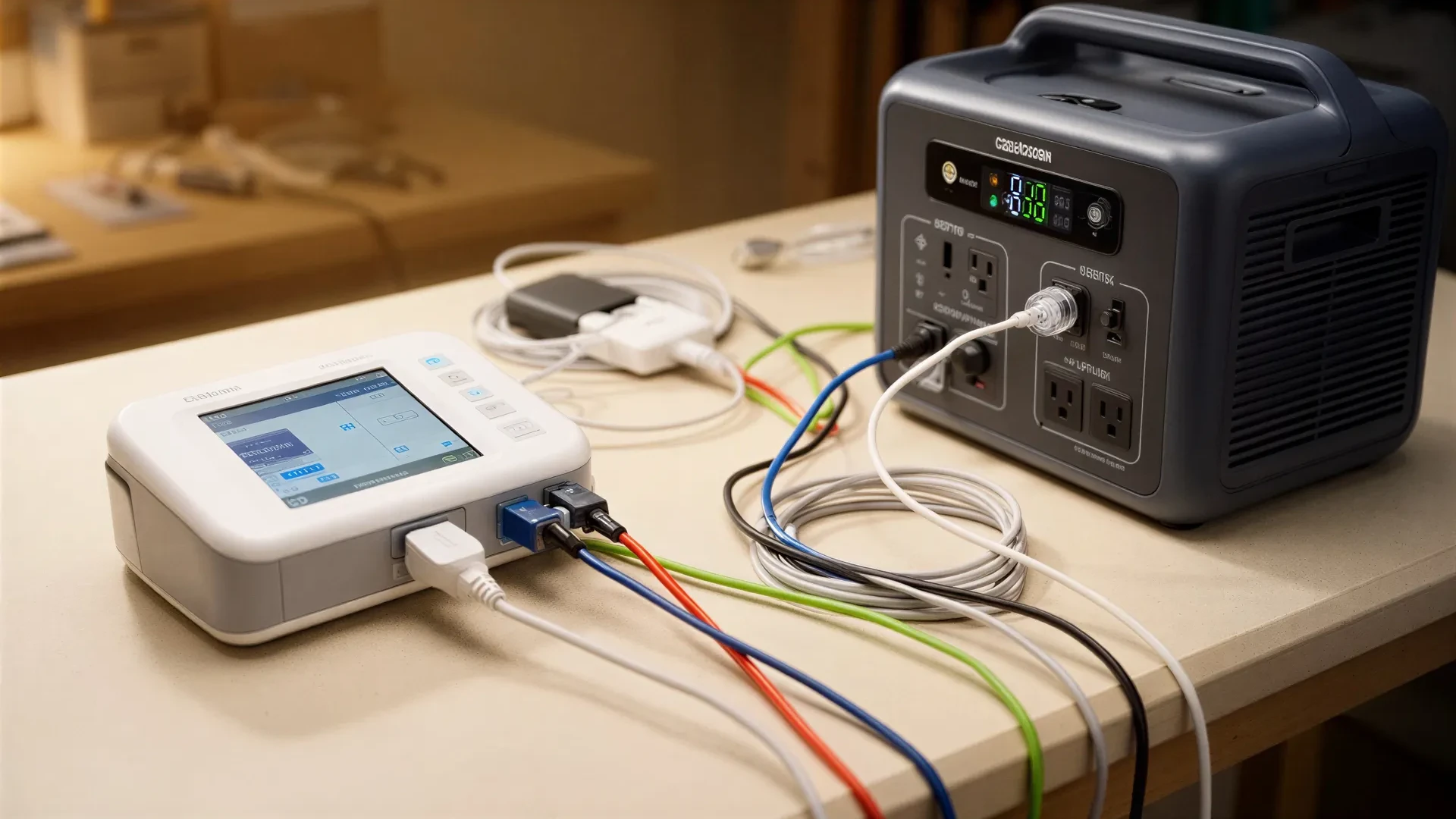
This is backup-power planning information, not medical advice. Follow your device manufacturer's instructions and ask your care team about treatment decisions.
For CPAP battery runtime, a verified DC connection usually beats using the battery’s AC outlet. The reason is conversion loss.
An AC path makes the battery imitate a wall outlet, then the CPAP power brick converts that wall power back to DC. A DC path keeps the energy in DC form and adapts it to the voltage the machine needs. Fewer conversion stages usually means more usable runtime from the same battery.
The important qualifier is verified. A random cable is not a safe or compatible DC path.
Short Decision Rule
Use this table before choosing the connection:
| Your situation | Better choice | Reason |
|---|---|---|
| You have the official or verified DC cable/converter | DC | Lower planning loss and fewer AC inverter surprises. |
| You only have the original CPAP wall power brick | AC | Often the known-compatible fallback. |
| Voltage, polarity, or connector is uncertain | Stop and verify | A fitting plug is not proof of compatibility. |
| Battery DC port cannot supply enough current | AC or a different battery | Undersized DC ports can shut off or fault. |
| Manufacturer guidance names a specific adapter | Follow that guidance | Compatibility outranks efficiency. |
Do not choose DC because it sounds more efficient. Choose it when the machine, cable, voltage, connector, and battery output all match.
The wrong lesson from this topic is “DC is always better.” The right lesson is “verified DC is more efficient.” A verified DC path has a known voltage, connector, polarity, current rating, and machine match. Without that evidence, AC with the original wall adapter can be the safer temporary path even though it uses more battery.
That tradeoff matters because CPAP batteries are often used when the user cannot tolerate surprises: overnight outages, travel delays, RV stops, and camping nights. Runtime is only useful if the machine keeps running normally.
What Happens In A DC Path
A DC path keeps battery energy in the same general form:
battery DC -> regulated DC or DC-to-DC converter -> CPAPThat could mean a native 12 V CPAP running from a regulated 12 V output. It could also mean a 12 V battery port feeding a 24 V DC-to-DC converter for a 24 V machine. A dedicated CPAP battery with the right machine output belongs in the same broad category.
The ResMed Battery Guide gives DC converter tables for supported ResMed systems. That matters because the guide ties current draw to pressure, tubing, and heated-feature configurations instead of using a generic adapter rating.
For planning, this site uses 0.93 as a site planning assumption for a verified DC cable or DC-to-DC converter path. It is not a manufacturer rating or a universal measurement. Real setups include regulator, cable, and port losses.
Do not use the current BiXPower ResMed converter page as exact compatibility evidence: its description identifies a 12V-to-24V AirSense 10 converter but another specification on the same page lists a 19V output. Until the manufacturer resolves that conflict, do not rely on its output value or connector fit; use an exact, manufacturer-documented cable or converter instead.
There are several DC paths, and they are not equal. A native 12 V machine running from a regulated 12 V output is different from a 24 V ResMed machine running through a 12 V to 24 V converter. A dedicated 24 V CPAP battery is different again. They all avoid the AC inverter, but they still need the right output and enough current.
For a 24 V machine, the cable may contain a converter. For a 12 V machine, the cable may be closer to a direct regulated path. For USB-C setups, the cable may need to request a PD voltage and then raise or regulate it. The label “DC” does not tell you which of those is happening.
What Happens In An AC Path
An AC path is convenient:
battery DC -> inverter AC -> CPAP power brick DC -> CPAPIt is also less efficient. The inverter has overhead, and the CPAP power brick has its own conversion loss. DOE Level VI rules and technical summaries for external power supplies explain minimum efficiency requirements for many AC-to-DC supplies, but those rules do not remove the inverter stage from a portable power station.
The current site planning assumption for AC is:
0.80 inverter stage x 0.88 power brick stage = about 0.70 combined efficiencyThat 0.70 value is not a product rating or DOE-established portable-station measurement. It is a conservative site planning assumption, especially because small overnight CPAP loads may sit far below an inverter’s most efficient operating point.
Low-load inverter behavior is the part many runtime charts miss. A power station inverter may look efficient near its rated output, but a CPAP can be a small load compared with a 300 W, 800 W, or 1,800 W inverter. Fixed inverter overhead then becomes a bigger share of the total draw.
That is why a battery can lose runtime through AC even when the CPAP itself is efficient. The inverter has to stay awake all night. The CPAP power brick then performs another conversion. The machine only sees the final DC output, but the battery paid for every stage.
Same CPAP, Different Battery Requirement
Assume the CPAP needs 240 Wh at the machine for one night before reserve:
| Connection path | Planning efficiency | Battery-side Wh before reserve |
|---|---|---|
| Verified DC cable or converter | 0.93 | 258 Wh |
| AC outlet plus CPAP power brick | 0.70 | 343 Wh |
Now add a 50% reserve:
| Connection path | Battery-side Wh with reserve |
|---|---|
| Verified DC cable or converter | 387 Wh |
| AC outlet plus CPAP power brick | 514 Wh |
The machine did not change. The night did not change. The extra battery requirement comes from the connection path.
Now apply usable capacity. A 500 Wh LiFePO4 station might be planned at about 450 Wh usable under the local default. That could cover the DC example with reserve, but it may be tight or fail for the AC example once age, temperature, and other loads are included. The same nameplate battery can pass one path and fail the other.
This is the practical reason to test both paths if you own the cable. Run the CPAP for a known period on AC, record the battery drop, then repeat on verified DC with the same settings. The difference is often more persuasive than any percentage in an article.
Voltage And Current Checks Come First
The biggest DC mistake is treating “DC output” as one universal thing. CPAP machines can use different voltages and connectors. Some machine families use 24 V input. Some use 12 V. Some require a specific converter.
Before using a DC cable, confirm the CPAP model, the exact input voltage, and the output rating printed on the official adapter. Then match connector size, polarity, battery output voltage, and battery current limit. If the manufacturer names an official DC converter or cable, start there.
The machine compatibility guide explains this as a three-part check: electrical input, supported connection path, and runtime-draw source quality. That check matters more than the efficiency gain.
Also check the power station port. Many 12 V sockets are limited to 10 A, which is 120 W before any cable losses. That is enough for many CPAP paths, but not proof for every heated setup or advanced PAP machine. Some USB-C ports advertise 100 W or 140 W, but voltage negotiation and cable type still matter.
If a port shuts off, the cable warms, the CPAP restarts, or the battery reports overload, treat the test as failed. Do not keep trying random tips until one appears to work. Go back to the machine manual, official adapter, and battery output specs.
When AC Is The Right Temporary Choice
AC is not automatically wrong. It is often the practical choice when the original CPAP power brick is the only verified adapter you have, the power station has an appropriate pure sine wave inverter, and the battery is large enough to absorb the extra loss.
AC also makes sense as a temporary fallback when you have not verified the DC cable or when the manufacturer documentation does not support the cable you found. In those cases, calculate with the AC loss. Do not use a DC runtime claim and hope it applies.
AC can also be the better caregiver setup. A caregiver may understand “plug the normal CPAP brick into this outlet” faster than a bag with several barrel tips and converter labels. If the battery is large enough and the need is short, simplicity can outrank efficiency.
The same logic applies in a hotel or hospital-adjacent travel situation where the original power brick is the only fully known accessory in the bag. Use the known path, then size the battery for the loss.
When DC Is Worth The Extra Verification
DC is usually worth the extra verification when the battery is close to the minimum size, the outage plan needs more than one night, or the travel battery has limited watt-hours. It also helps when you want less heat and less idle drain.
For a small battery, the difference between 0.93 and 0.70 can decide whether the setup lasts the night. The gain is real only if the cable path is correct.
DC is also worth verifying for multi-night planning. A 30 percent loss may be tolerable for one short fallback. Across two or three nights, it can become the difference between needing one mid-size battery and needing a larger power station plus a recharge plan.
For RV and van use, DC often fits the electrical system better because many rigs already have a 12 V house battery path. The same warning still applies: the CPAP adapter must match the machine, and the outlet circuit must support the load.
Do Not Compare Runtime Claims Without The Path
Two runtime claims can both be technically true and still not describe your setup.
One claim may assume a DC cable, no heated humidity, low pressure, a new battery, and no reserve. Your setup may use the AC outlet, heated humidity, higher pressure or leaks, an older battery, and a reserve margin.
Those are not the same scenario. The runtime number only travels with the assumptions that created it.
Before copying a runtime claim, look for the path language. Words like “using the DC adapter,” “humidifier off,” “AC outlet,” “pass-through,” and “inverter” change the result. If the claim does not name the path, it is incomplete.
The path should also appear in your own notes. A battery test that says “ran 8 hours” is less useful than “ran 8 hours, AC outlet, humidifier off, battery dropped from 100 percent to 42 percent.” The second note can be compared, repeated, and improved.
Pure Sine Wave Still Does Not Remove The Loss
A pure sine wave inverter is usually the right AC inverter type for sensitive electronics. It is not the same as an efficient CPAP battery path. Pure sine wave describes the shape of the AC output. It does not remove inverter idle draw, power-brick loss, or the fact that the battery is converting DC to AC so the CPAP brick can convert AC back to DC.
This distinction matters when comparing power stations. A product can have a good pure sine inverter and still lose meaningful runtime at CPAP loads. The inverter may be designed for laptops, appliances, or higher loads. A CPAP running through that inverter all night may sit in a low-load zone where fixed overhead matters more.
Use pure sine AC when AC is the chosen path, especially when using the CPAP power supply as designed. But do not use pure sine as a reason to ignore the DC path. Waveform quality and runtime efficiency are different questions.
Setup Examples
For a ResMed AirSense 10 or AirSense 11 class 24 V machine, a verified DC path usually means a machine-specific 12 V to 24 V converter or a dedicated 24 V CPAP battery. The cable and connector must match the exact generation. AirSense 10 and AirSense 11 should not be treated as the same cable purchase.
For many Philips DreamStation class machines, the power system is closer to a 12 V path. That can be efficient when the battery output and cable are correct. But the same warning applies: voltage alone does not prove the connector, current rating, or accessory support.
For a travel CPAP, the answer depends on the ecosystem. AirMini, Transcend, Breas, and similar machines can be excellent low-power candidates, but proprietary connectors and third-party USB-C boost cables need careful verification. A low-draw machine with the wrong cable still fails.
For a caregiver setup, AC may win even when DC is more efficient. If the caregiver can safely plug in the normal CPAP power brick but cannot distinguish several DC tips, the AC path may be the better operational choice. Size the battery for the loss and test the transfer.
How To Test AC Against DC
Use the same CPAP setup for both tests. Keep the mask, pressure mode, humidifier state, heated hose state, room temperature, sleep duration, and other battery loads the same. Change only the connection path.
Start with AC if that is your current known-safe path. Record starting charge, ending charge, and hours run. Recharge the battery, then repeat with the verified DC cable. If the DC setup uses less battery and the machine runs normally, the cable verification paid off.
If the DC setup fails, do not count the efficiency benefit. A failed DC path is not a runtime upgrade. It is a compatibility problem.
What To Write On The Cable Label
A good label prevents mistakes during a dark outage or a hotel setup. Put the machine name, voltage, and battery port on the cable pouch. For example, “AirSense 11, 24 V converter, use with 12 V car port” is more useful than “CPAP cable.”
If the kit contains more than one tip, label each tip or remove the ones that do not belong to the current machine. Universal kits are most dangerous when several tips fit well enough to tempt a guess. The goal is to remove guessing from the outage plan.
Also label the fallback path. If AC is the emergency path, keep the original CPAP power brick with the battery. A power station is not useful if the only compatible power brick is still packed in a travel bag.
When The DC Gain Is Not Worth It
Sometimes the DC path is not worth chasing. If the battery is large, the outage need is short, and the original power brick is the only confirmed path, AC can be good enough. If the machine is used by a person who cannot manage cable checks, AC may also be better.
DC becomes more important when the battery is small, the trip is remote, the outage is likely to last more than one night, or the setup runs close to the battery limit. In those cases, the energy saved by avoiding AC can be the difference between a reserve and a shutdown.
AC Still Has A Role In UPS Planning
One place AC can stay useful is unattended failover. Many power stations and UPS units protect their AC outlets, not every DC port. If your main problem is a silent power flicker while asleep, an AC UPS path that passed a live unplug test may be better than a manual DC path that only works after you wake up.
That does not erase the runtime penalty. It means the outage plan may have two stages: AC UPS mode for automatic overnight failover, then a manual switch to verified DC if the outage continues after morning. Both stages need labels and testing.
Do not assume pass-through charging equals UPS behavior. Pass-through means the battery charges while powering a load. UPS behavior means the CPAP keeps running when wall power drops. The switchover test decides whether the AC path is good enough for sleep.
Final Rule
Use verified DC when the voltage, connector, polarity, current limit, and manufacturer guidance line up. Use AC when the original wall adapter is the only confirmed path or when the battery is large enough to absorb the loss.
For any estimate, write down the path. A CPAP battery plan without the connection path is not finished.
Next step: run the same setup through the CPAP runtime calculator once with DC and once with AC. The gap will show whether the cable verification is worth doing for your battery size.
Sources
- ResMed Battery Guide (manufacturer; retrieved 2026-09-01)
- BiXPower ResMed DC Converter Specifications (technical; retrieved 2026-09-01)
- DOE Level VI External Power Supply Efficiency Technical Paper (technical; retrieved 2026-09-01)